
Industry News


Hard to choose the right model to perfectly fit your needs? Here is a detailed guide.
Why Does the Same Industrial PC Chassis Have Different Chip Options — And Which One Should You Choose?
2026-05-21 15:37:28
When browsing industrial or embedded PCs, many buyers notice something confusing:
The systems look almost identical - same chassis, same I/O layout, same mounting options - yet they come with completely different processors.
One version uses Intel N100. Another uses Core i5. Another offers Core Ultra or AMD Ryzen AI.
So what actually changes? And how do you know which one you need?
The answer is simpler than it looks:
In industrial PCs, the chassis determines the deployment environment.
The processor determines the workload capability.
The enclosure, cooling design, voltage input, COM ports, mounting structure, and expansion capability are often shared across a product family. What changes is how much compute power, graphics performance, AI acceleration, and multitasking capability the system can handle.
Here's how to choose the right chipset when the hardware platform looks almost the same.
Step 1: If Your Workload Is Lightweight, Intel N100 / Alder Lake-N Is Usually Enough
For many industrial deployments, the workload is actually very light.
Typical examples include digital signage playback, IoT gateways, protocol conversion, SCADA frontends, remote dashboards, data aggregation, and simple HMI systems.
This is where Intel N100 and i3-N305 platforms make the most sense.
The N100 became popular for a reason: extremely low power consumption, fanless operation, lower heat generation, higher long-term reliability, and enough x86 performance for most edge workloads. In real deployments, many systems rarely exceed 20-30% CPU utilization. Upgrading to a higher-end processor often increases power consumption and thermal load without providing meaningful operational benefit.
For many edge deployments, stability and efficiency matter more than raw CPU performance.
Maxtang Products on This Chip
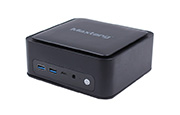
NX-N100 - Compact fanless embedded PC, dual 2.5GbE LAN, triple 4K display output (2x HDMI + USB-C DP), Wi-Fi 6, SIM slot, 127x127x45.6mm.
https://www.maxtangpc.com/products/NX-N100.html
SXC-ALN30 - Fanless embedded PC, 3x HDMI 2.0, 2x COM, 6x USB, 9V-35V optional, -20°C to 60°C.
https://www.maxtangpc.com/products/SXC-ALN30.html
IXALN-35 - Fanless industrial PC, 6x COM (RS-232/485), 4x USB 3.2, 9V-35V wide input.
https://www.maxtangpc.com/products/IXALN-35.html
DXALN-10 - Larger fanless industrial chassis, 6x COM, PCIe x4 expansion slot, dual LAN.
https://www.maxtangpc.com/products/DXALN-10.html
Step 2: If You Run Multiple Applications Simultaneously, Choose Core i5 / i7
Sometimes the issue is not a single heavy workload - it's workload concurrency.
Industrial systems often need to run SCADA software, database services, historian systems, multi-screen HMI, browser dashboards, edge analytics, OPC-UA communication, and local monitoring applications - all at the same time, continuously.
This is where Core i5 and Core i7 platforms become valuable. Compared to N-series processors, Alder Lake-U and Raptor Lake-U platforms provide higher sustained multi-core performance, better multitasking capability, larger performance headroom, and improved responsiveness under continuous load.
Another major factor is serial connectivity. Many industrial deployments still rely heavily on RS-232 and RS-485 devices. Industrial PC series built around Core i5/i7 platforms include 6x configurable COM ports, wide voltage input, and rugged fanless thermal design - making them suitable for PLC, CNC, and legacy equipment integration.
Maxtang Products on This Chip
IXH-AL35 - Fanless industrial PC, 6x COM (RS-232/485 configurable), 2x HDMI, 8x USB, 12V-35V Phoenix connector, -20°C to 60°C.
https://www.maxtangpc.com/products/IXH-AL35V1_0.html
DXAL10V2.0 - Fanless industrial chassis, 6x COM, 4x HDMI 2.0, PCIe x4 expansion, dual LAN (1GbE + 2.5GbE).
https://www.maxtangpc.com/products/DXAL-10.html
SXC-RL30 - Compact fanless embedded PC, 4x HDMI 2.0, 2x COM, DDR5, 9V-36V input.
https://www.maxtangpc.com/products/SXC-RL30.html
FXAL-10V2.0 - Active cooling, 4x HDMI 2.0, 1x COM, PCIe x4 expansion, supports Core i7-1360P for maximum sustained performance.
https://www.maxtangpc.com/products/FXAL-10V2_0.html
Step 3: If AI Inference Is Involved, Move to Intel Core Ultra
This is where many buyers start seeing newer versions of the same chassis using Intel Core Ultra processors.
The reason is AI acceleration. Core Ultra platforms introduce a dedicated NPU, designed specifically for AI inference workloads. This matters for applications like vision inspection, smart retail analytics, predictive maintenance, anomaly detection, edge AI inference, and local LLM deployment.
On older platforms, AI inference competes directly with CPU resources. During continuous inference workloads, CPU utilization spikes, which can impact system responsiveness. Core Ultra changes this by offloading AI workloads to the NPU, allowing the CPU to remain available for I/O handling, network communication, display rendering, and application logic.
The result is more efficient continuous inference at the edge - without changing the chassis.
Maxtang Products on This Chip
SXC-ARL30 - Fanless compact embedded PC, Core Ultra 5/7 (Meteor Lake/Arrow Lake), 4x HDMI 2.0 + USB-C DP, Intel Arc GPU on select SKUs, DDR5 up to 96GB, 9V-36V input.
https://www.maxtangpc.com/products/SXC-ARL30.html
MTN-MTL50 - NUC form factor, Core Ultra 5/7, Thunderbolt 4, DDR5 up to 96GB. For compact AI workstations in space-constrained deployments.
https://www.maxtangpc.com/products/MTN-MTL50.html
Step 4: If Graphics and Display Capability Matter Most, Choose AMD Ryzen
Some deployments care less about CPU compute and more about display capability.
Examples include video walls, multi-screen signage, visualization systems, control room displays, camera monitoring dashboards, and real-time rendering environments.
This is where AMD Ryzen platforms stand out. AMD Radeon integrated graphics typically provide stronger multi-display capability, smoother rendering for video-heavy workloads, and higher display bandwidth. This is why many embedded PC product families offer both an Intel version - optimized for compute and industrial compatibility - and an AMD version optimized for graphics and multi-display workloads, inside the same physical chassis.
Maxtang Products on This Chip
SXC-FP530 - Fanless compact embedded PC, AMD Ryzen Embedded R2314/R2514, 4x HDMI 2.0 native quad display, 2x COM, 9V-35V Phoenix optional, -20°C to 60°C.
https://www.maxtangpc.com/products/SXC-FP530.html
FXFP-510 - Active cooling, AMD Ryzen Embedded R2314/R2514, 4x HDMI 2.0, 2x COM, PCIe x4 expansion.
https://www.maxtangpc.com/products/FXFP-510.html
FXFP-710 - AMD Ryzen AI Pro 8845HS, 4x DisplayPort 1.4, 2x COM, PCIe x4, DDR5 up to 96GB. For the highest graphics compute requirement in the lineup.
https://www.maxtangpc.com/products/FXFP-710.html
IXH-FP535 - Fanless industrial PC, AMD Ryzen Embedded R2000, 6x COM, rugged chassis. For industrial deployments combining visualization with serial equipment integration.
https://www.maxtangpc.com/products/IXH-FP535.html
Step 5: So Which One Should You Actually Choose?
The easiest way to decide is to focus on workload type - not processor branding.
| If your priority is... | Recommended Platform |
| Lowest power consumption | Intel N100 / N305 |
| Fanless long-term reliability | Intel N100 series |
| Better multitasking | Core i5 / i7 |
| Industrial automation / serial devices | Alder Lake-U / Raptor Lake-U |
| AI inference acceleration | Intel Core Ultra |
| Multi-display graphics | AMD Ryzen Embedded |
| Maximum compact performance | Ryzen AI / Core Ultra H |
The Important Thing Most Buyers Miss
In embedded computing, "more powerful" does not automatically mean "better."
The best processor is the one that matches the actual workload, thermal environment, power requirements, and long-term deployment conditions.
That's why industrial PC product lines often reuse the same chassis across multiple chipsets: because the deployment environment stays the same, while workload requirements change.
Choosing the right processor is really about choosing the right balance between performance, thermals, graphics, AI capability, and operational efficiency.
Full product lineup: https://www.maxtangpc.com/products/
Related Article
-
 Best ATX Motherboard Manufacturers in 20242024-06-24Discover the world of ATX motherboards with our comprehensive guide Learn about their history, variations like microATX and EATX, and how to choose the right one for your needs Whether you re a gamer, PC enthusiast, or involved in industrial applicatio
 -
Understanding USB Type-C, USB 3.1, USB 3.2, USB4, and USB4 V22024-06-24Explore the evolution of USB technology from USB Type-C to USB4 V2 in our comprehensive blog Understand USB 3 1, USB 3 2, and USB4, including their features, data transfer speeds, power delivery capabilities, and compatibility Learn how these advancemen
-
 Maxtang at COMPUTEX Taipei 20242024-05-30Join Maxtang Computer at COMPUTEX Taipei 2024, the premier tech event in Taiwan! Discover the latest in IT and electronic products from June 4-7 at Nangang TaiNEX 2 Relive the excitement of COMPUTEX 2023 and get ready for another year of groundbreaking i


